Haffner Energy launches the C-iC modular units line to unlock financing for midsize biofuel projects
Vitry-le-François, January 27, 2026, at 8:00 a.m. (CET)

Haffner Energy announced today the launch of its new C-iC modular industrial units line[1], designed to address the financing and deployment challenges facing medium-scale, decentralized biofuel projects. By removing key economic barriers, this approach makes mid-sized projects financeable and enables their realization without reliance on subsidies.
A product line targeting medium-sized decentralized projects
The C-iC line is built on Haffner Energy’s H6 technology, unveiled in November 2025. Each unit is sized to produce 1,700 kW of renewable syngas for thermal applications or for further conversion into biomethane or biomethanol, or up to 50 kg per hour of renewable hydrogen (approximately 400 tonnes per year[2]).
Three configurations tailored to end uses, delivering unprecedented biofuel production costs
The C-iC line is available in three configurations, all built on a highly standardized industrial platform:
- SYNOCA® C-iC is dedicated to syngas production for industrial thermal and energy applications, serving as a direct alternative to biomass boilers. This configuration delivers more competitive thermal energy while significantly reducing CO₂ emissions[3] compared with the direct combustion of solid biomass.
- SYNOCA®+ C-iC integrates syngas production modules whose composition and purity are compatible with conversion into biomethane or biomethanol [4], while maintaining the same objective of economic competitiveness.
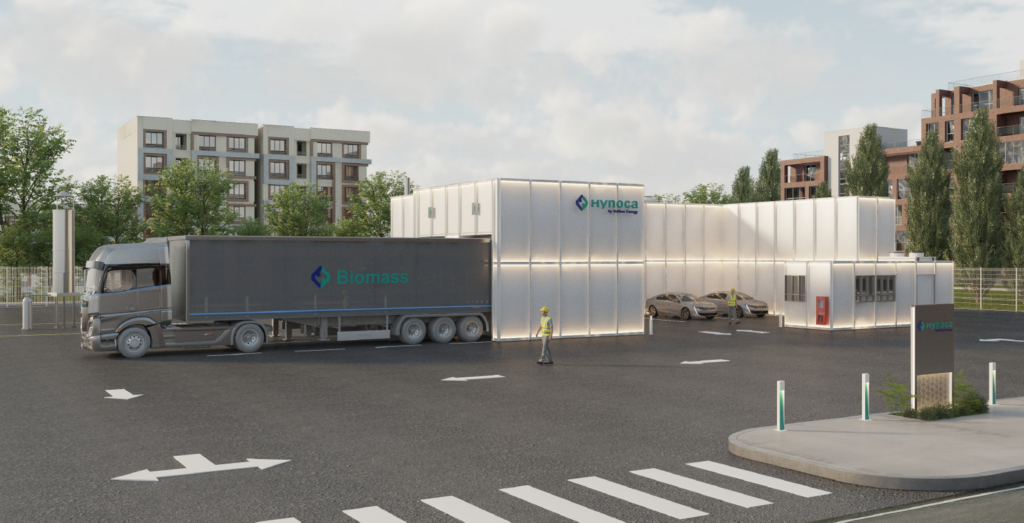
- HYNOCA® C-iC enables the production of renewable hydrogen for industrial or mobility applications at a levelized cost of hydrogen (LCOH) [5] of less than €2.34/kg[6], with guaranteed purity levels in line with market standards.
This modular approach allows multiple markets to be addressed from a single technological base, offering a value proposition that is currently unmatched for medium-sized projects. It enables syngas and hydrogen production at unprecedented production cost levels for this market segment worldwide, regardless of the technology used to produce renewable syngas or hydrogen.
Modular architecture at the core of the value proposition
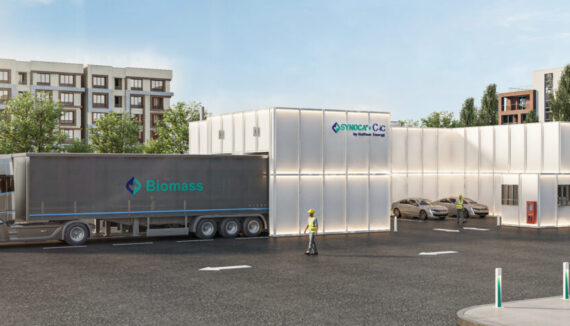
The C-iC range is built on a fully modular and highly standardized architecture. Each unit is entirely pre-assembled and pre-equipped at the factory, then delivered to site as standard modules using conventional transport. On-site assembly is limited to simple operations, such as bolted mechanical connections, plug-in connectors and removable cladding. This design enables installation and commissioning in less than two weeks, with no significant civil engineering work required.
The mobility of the units also represents a key financing lever, enabling leasing or finance-lease structures and further improving project bankability.
Significant reductions in CAPEX and lead times
This modular approach reduces overall project CAPEX by approximately 30% to 40%, all else being equal, primarily by eliminating lengthy and complex construction phases and delivering substantial savings in civil engineering.
Project lead times are reduced by three to four months, with the on-site construction and installation phase limited to less than two weeks.
“Faced with very insufficient public support, medium-sized projects are caught in a chicken-and-egg paradox: due to excessive CAPEX, they remain non-financeable[7]. By launching the C-iC line, the first unit of which will be commissioned this quarter in Marolles, we are breaking this paradox. Projects are becoming financeable, without relying on subsidies,” explains Philippe Haffner, CEO of Haffner Energy.
“I am very enthusiastic and confident that this line marks a turning point for Haffner Energy, as it finally enables medium-sized projects to come to fruition. We anticipate significant financial effects from the fiscal year beginning April 1 this year,” he adds.
Operations adapted to local resources
Like all technologies developed by Haffner Energy, the C-iC line is biomass-agnostic and offers a high tolerance for moisture content, up to 55%. This flexibility simplifies and secures feedstock supply, requiring approximately 3,200 tonnes of dry plant biomass per year.
Reservation system launching in February
Orders for the C-iC line will be taken through a reservation system scheduled to launch on February 18, 2026. The first units are expected to be commissioned in summer 2027. Further details on the reservation process will be communicated at launch.
About Haffner Energy
Haffner Energy is a company specializing in sustainable biofuels. With 33 years of experience, it has developed expertise in decarbonizing mobility and industry through the production of competitive renewable biofuels. Its innovative and patented biomass thermolysis technology enables the production of Sustainable Aviation Fuel (SAF), as well as renewable gas, hydrogen, methanol, and methane. The company also contributes to the regeneration of the planet through the co-production of biogenic CO2. For more information: http://www.haffner-energy.com
Sales Relations
Investor Relations
investisseurs@haffner-energy.com
Press Relations
laetitia.mailhes@haffner-energy.com / +33 (0)6 07 12 96 76
[1] C-iC is a range that includes a single standardized size: C stands for Core.
[2] This is equivalent to a 4.1 MW alkaline electrolyzer or a 4.5 MW PEM electrolyzer, with a load factor of 5,000 hours per year.
[3] The combustion of biomass generates more pollutants than the combustion of fuel oil, including NOx, dust, and PAHs, even with the latest generation of flue gas treatment systems. Emissions from the combustion of syngas are comparable in quality to those from the combustion of natural gas, without the fossil CO2 produced by the latter.
[4] Methane or methanol conversion units are not part of Haffner Energy’s basic offering, but can be integrated into the SYNOCA@+ C-iC version.
[5] Levelized Cost of Hydrogen: this is the total cost of hydrogen delivered at 30 bar, including CAPEX depreciation, OPEX, maintenance, utilities, and input costs. However, financial depreciation and the operator’s margin are not included in the LCOH, which is therefore not a selling price. The cost of distribution, compression above 30 bar, and hydrogen transportation are not included.
[6] Within the European Union, according to consolidated data from the European Hydrogen Observatory and the European Commission’s Joint Research Center, the levelized cost of hydrogen (LCOH) from a 5 MW electrolyzer, operating at a load factor of 5,000 hours per year, is between €6 and €7.5/kg H₂ without subsidies. If 50% of the CAPEX is covered by a non-repayable subsidy—a rare and highly selective mechanism—the LCOH is reduced to between €3.5 and €5.5/kg H₂, with the lowest costs observed in Portugal.
[7] To be financeable, a project must generally have a debt service coverage ratio (DSCR) of more than 1.3, which is very rarely the case for medium-sized renewable gas and hydrogen projects due to excessively high CAPEX levels.