By the way, what are the key challenges facing SAF and renewable diesel?
by Philippe Haffner, Haffner Energy CEO
SAF production pathways and the challenges they face are still often poorly understood.
Some are surprised that Haffner Energy is not active in the eSAF segment. eSAF is produced using renewable electricity to generate hydrogen, which is then combined with CO₂.
Its main drawback: cost. It is 5 to 6 times more expensive than fossil-based jet fuel, and its deployment currently relies on specific regulatory mandates.
Yet jet fuel already accounts for approximately 30% of airlines’ operating costs. The cost of SAF is a decisive factor in its large-scale deployment.
At Haffner Energy, we have made a different choice: bioSAF.
But not just any bioSAF.
Both the energy and carbon come from residual biomass. The best-known bioSAF pathway, HEFA, uses recycled oils and fats, which are limited in availability and very expensive: €1,000 to €1,200 per tonne, equivalent to €100–120/MWh.
There is a far more abundant and cost-effective resource: solid residual biomass, costing between €20 and €30/MWh. To convert it into SAF, the most conventional pathways involve producing syngas, which is then converted into liquid fuels through Fischer-Tropsch synthesis or the Methanol-to-Jet process (see our press release dated September 22, 2026).
These processes work, but they are complex and highly capital-intensive.
Haffner Energy offers a third pathway that is simpler and far more cost-effective: Rather than converting solids into gas and then gas into liquids, we convert solids directly into liquids.
The thermolysis stage of our SYNOCA® process already does this: it converts biomass into an oil that is subsequently hydrotreated using equipment similar to that employed in the HEFA pathway. This is our SB-HEFA technology.
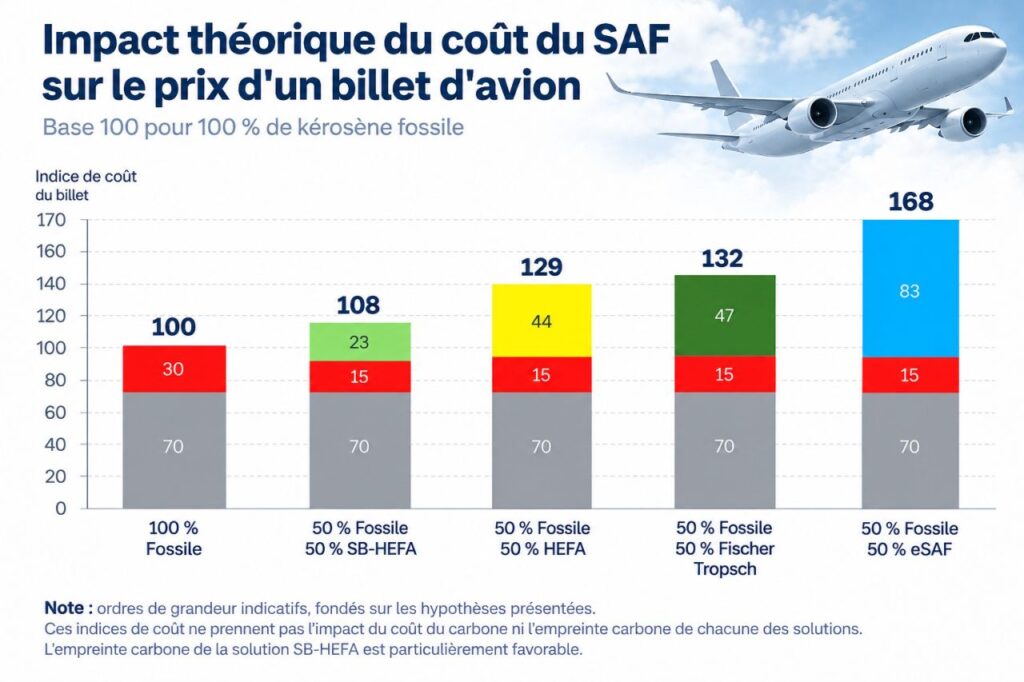 Our objective: to approximately halve the cost of SAF produced from solid biomass, with CAPEX around three times lower than conventional pathways and higher energy efficiency.
Using the same equipment, but with different operating settings, we can also produce renewable diesel and intend to do so as soon as possible, with the firm ambition of becoming a leading player in SAF and renewable diesel.
Because the real challenge is to produce these renewable fuels at a cost very close to that of fossil fuels.
This is the key to achieving rapid, large-scale decarbonization of heavy-duty transport and aviation.