Biomass, a strategic imperative
In the face of geopolitical tensions, volatile fossil fuel prices, and the climate emergency, energy independence is no longer optional—it is a strategic imperative.
Today, biomass stands as one of the most robust levers for strengthening European energy sovereignty.

Is the potential of biomass truly significant?
Yes—and it is considerable.
A peer-reviewed scientific study published in 2019 (Renewable and Sustainable Energy Reviews, Volume 100, February 2019, pages 127–142) estimates that unexploited residual biomass in Europe represents an energy potential of around 8,500 TWh per year—approximately 1.5 times Spain’s annual energy consumption (Our World in Data).
Furthermore, according to a 2024 report by the International Energy Agency, around 60% of the renewable energy consumed in Europe currently comes from biomass.
This makes it:
- the leading source of renewable energy in Europe
- an already operational pillar of the energy transition
- a strategic tool for supply security
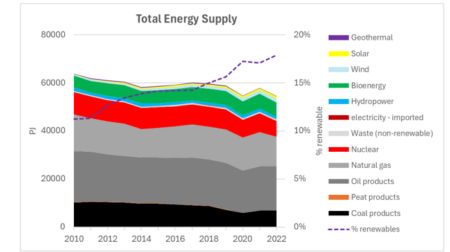
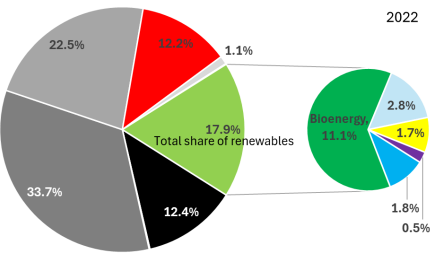
The contribution of bioenergy to energy resources in the EU27 in 2022
The share of renewable energy in total energy resources has increased significantly since 2010 (purple dotted line). There has been growth in solar, wind, and biomass-based energy (bioenergy), while coal, fossil fuels, and natural gas have declined between 2010 and 2022.
(Source: IEA – World Energy Balances and Renewables Information 2024)
Is energy from biomass truly renewable?
According to the United Nations, energy is considered renewable when it comes from natural processes that are continuously replenished. Biomass, derived from plant or animal organic matter, regenerates naturally and quickly—unlike oil, coal, or gas, which take millions of years to form. As such, it fully belongs to the renewable energy mix, alongside solar, hydropower, and wind energy.
Biomass relies on a short carbon cycle: the amount of CO₂ emitted during its use matches the amount of CO₂ previously captured during plant growth.
Regulation
The European RED III Directive (Renewable Energy Directive), which is legally binding for the 27 EU Member States, recognizes energy derived from specific categories of biomass as renewable.
The following are considered sustainable:
- agricultural residues
- wine industry by-products (grape marc, wine lees)
- organic municipal waste
- livestock effluents (manure, slurry)
- forestry residues
This European framework ensures that biomass used for energy production follows principles of sustainability and traceability.
Does biomass create usage conflicts?
The RED III Directive explicitly excludes feedstocks that could compete with food production or encourage deforestation.
Renewable energy from biomass primarily relies on:
- waste
- residues
- unexploited co-products

Caption:
Sargassum seaweed washed ashore: while these algae illustrate ecological disruptions linked to pollution and climate change, they also represent a potential source of renewable energy. They can transform an environmental burden into an energy resource and economic opportunity, particularly in the Caribbean and certain coastal African countries.
It is therefore not about using agricultural land intended for food production, but about transforming existing, underutilized flows into strategic energy resources.
At Haffner Energy, the technology is designed to create value from a wide range of locally available biomass. This flexibility makes it possible to:
- utilize unused resources
- reduce transportation of raw materials
- maximize local integration and the local circular economy
A local energy, produced from local resources, for local energy sovereignty.
Haffner Energy’s vision
In a context of global energy instability, biomass is not just a renewable energy source—it is a concrete lever for industrial resilience and energy sovereignty.
This lever is optimized by Haffner Energy’s technology, which is compatible with ALL types of biomass: agricultural and forestry residues, Municipal Solid Waste, digestate, livestock manure, and more. Being feedstock agnostic guarantees full access to available, untapped resources, regardless of seasonal, geographic, or climatic variations.
By transforming untapped local resources into sustainable fuels and low-carbon energy, Haffner Energy contributes to:
- securing supply chains
- reindustrializing territories
- reducing carbon footprints
- strengthening European strategic autonomy
The energy transition does not rely solely on technological innovation. It also depends on our collective ability to intelligently mobilize available resources.
Biomass is a key part of that equation.